
Written by Eric Anderson
My journey began in my first year of graduate school when I attended my advisor, Dr. Anna Osterholtz’s, Bioarchaeology field school in Croatia. Here I discovered first hand how difficult it was to travel with my personal dig kit. As you all may know, trying to create a balance of personal clothing, work clothes, and tools without having multiple bags is quite the challenge. While in Croatia, I spoke with Dr. Osterholtz about the travel issues and she brought up the same problem that occurs with transporting osteometric boards. After some discussion, I told her that I knew I could create an osteometric board that was easier to transport than the currently available models. This conversation set the stage for me to start working on a portable osteometric board, specifically to have one ready for the following year when I was meant to return with Dr. Osterholtz to Croatia as her TA and collect data for my thesis.


As for everyone’s plans in 2020, my plans to return to Croatia were derailed due to the Covid-19 pandemic. Unable to return to Croatia due to shutdowns and travel restrictions, I was forced to abandon my thesis topic and to start brainstorming another. During this time, I was still working on making this portable board. I was workshopping with various materials such as velcro, fiberglass, and magnets trying to come up with a method and design that was practical and portable. After some time and frustration, I came up with the idea to possibly use laser sensors instead of using a manual measuring method, like the traditional osteometric board design.
I spoke with my advisor about my current problems with my thesis topic and my progress on making the portable osteometric board. She suggested that I make my side project – the portable osteometric board – into my new thesis topic. This became the answer to my current thesis problem and allowed me to shift my focus full-time into making this new board a reality. Once I pivoted, I was able to finally come up with the solution for a portable osteometric board called the Portable Osteometric Device (POD).
The development process for the POD started by breaking down the design of the traditional osteometric board to its essential elements and determining how it operated. The traditional osteometric board consists of a single board base with a fixed panel, which the object is secured against, and a sliding panel, which is adjustable in order to determine the object’s maximum length. Examining the design at this level showed that the board (i.e., the measuring base) is crucial because the object’s length cannot be determined without it. To transform and increase the efficiency of the design, I first began by asking how I could remove this critical aspect while still accurately measuring objects.
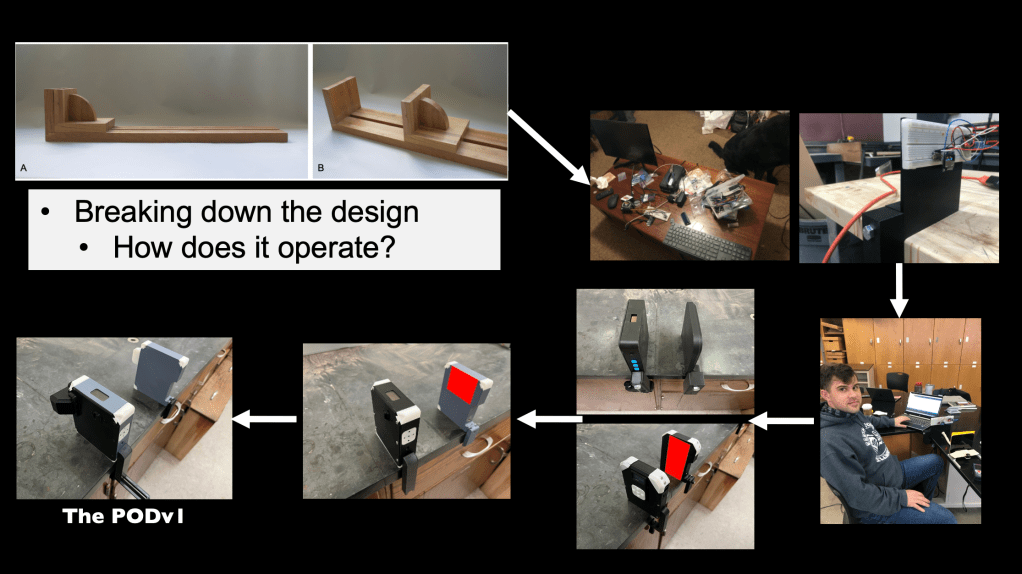
The answer to this question came by removing the board and using laser sensors with time-of-flight technology to measure distance. After some concept testing, I showed that using a laser sensor was plausible and began testing different designs. This eventually led to the development of the Portable Osteometric Device version 1 prototype (PODv1).
The PODv1 is a battery-operated, portable research tool that is 3D printed and uses laser sensor technology to measure an object’s length. The PODv1 uses a laser distance measuring sensor module with direct time-of-flight technology to take length measurements.
The POD uses two primary components:
- The Laser Panel contains the laser and control unit for the device and attaches to the side of any table using its clamp.
- The Sliding Panel is used to house the PODv1 Clamp parts and to sandwich the material being measured.
After the object is placed between the two panels, the laser reflects off of the sliding panel back to the laser panel for an accurate measurement to be displayed on its LCD screen.
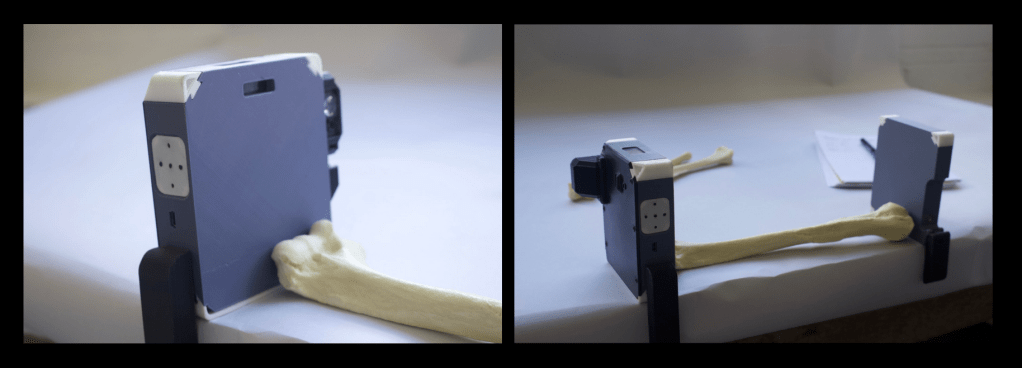
The POD has four different operating functions:
- Live Mode automatically engages after turning the POD on and displays a continuous measurement. This mode displays an active 25%, midpoint, and 75% of the measured object. It also displays the last Precision mode measurement taken under the Live measurement reading.
- Precision Mode takes 20 measurements and displays the average of these measurements.
- Calibration calibrates the device using a 100mm block that is incorporated into the POD’s design
- History shows the last five Precision Mode measurements.
In 2021, myself and others tested the reliability and validity of the PODv1 against the Paleo-Tech Lightweight Field Osteometric Board.
This study showed the PODv1 to be a reliable and valid measuring device as well as bringing to light the limitations of both devices, highlighting ways the POD could be improved for research. These changes include modifying the laser’s position to the top of the device, fixing the calibration issue, and adding more stabilization features.
Moving the laser to the top and center of the Laser Panel moves the target region to the center of the Sliding Panel, minimizing error due to misalignment of the device. A calibration issue was noticed and easily rectified with software improvements to save and maintain calibration. The stabilization problem was due to the sliding panel’s slim base and its light weight making it very wobbly. This has been improved by adding weight to the sliding panel.
The volunteers expressed that they were not confident that they were keeping the panels straight and suggested some type of visual alignment feature, which has been addressed by adding a base mat in efforts to help with consistent alignment. The last suggestion the volunteers mentioned was their fear of dropping or knocking the bone element off the table due to being so close to the edge.
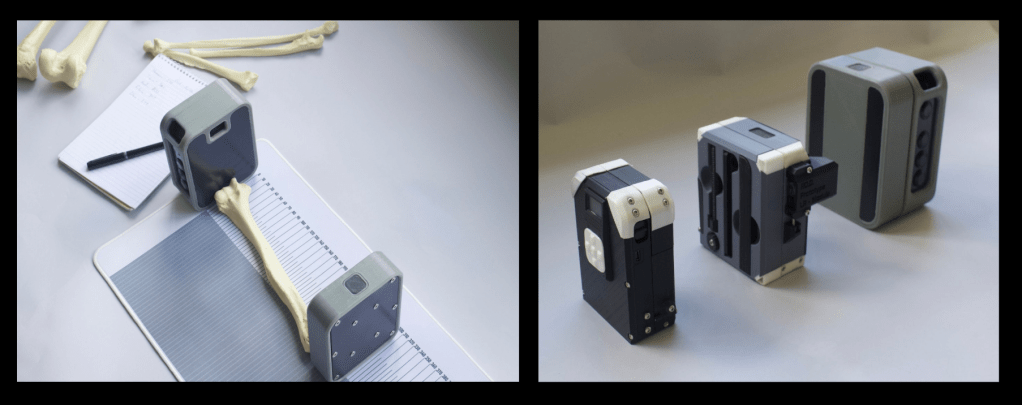
Since the study, we have made all the improvements and suggestions found from the study into the current model of the PODv1 and have added other improvements. We have made some user friendly software improvements and increased the number of measurements taken and average in precision mode to 40. The PODv1 now has a flexible mat that the laser panel attaches to for stabilization and allows for visual alignment and manual use if the PODv1 battery dies. It has less moving components and the panels attach to each other making it even easier to transport. Finally, we are currently working on a companion APP for the POD with added Bluetooth capabilities that will allow for the transfer of data to decrease transcription error and data collection time.
My journey from anthropologist to entrepreneur has made me experience and think about anthropology in ways I normally would not come across. I believe that the field of anthropology requires its practitioners to constantly continue to learn and adapt in order to understand an ever-changing world. I was able to build on this anthropological skill to expand outside of the anthropological avenue into the engineering and business sphere to learn how to make laser sensors operate and understand how to create a product and business. Throughout this process, I have come to appreciate collaboration with those more experienced than me in these areas, especially those in business, electronics, and software. When collaborating with these groups, I noticed they tend to ask questions that are more applied than theoretical, on subjects that I previously did not think about or put much thought into, such as starting our company Advanced Research Collection Technologies, LLC (ARCTECH). This provided us with an array of opportunities including collaboration and funding to grow in ways we would not be able to otherwise.
Without these collaborative experiences and the support of Mississippi State University’s Entrepreneur Center, the Cobb Institute of Archaeology, and the National Strategic Planning & Analysis Research Center, the POD would have never left the drawing board.
In continuing with that spirit, I have partnered with fellow anthropologists Sierra Malis and Dale Pate to help make ARCTECH a place for the anthropological, forensic, and archaeological community to obtain a reliable and portable osteometric device in efforts to improve efficiency, reliability, and ease in osteological documentation and analysis. I believe that we are a great example of thinking outside the board, and we hope our fellow anthropologists and archaeologists will be inspired to continue in rigorous research, and even continue to invent new ways to help push our discipline into more applied and Entrepreneurial avenues for the better.
 Advanced Research Collection Technologies
Leave a comment